Events
jora.tech at Processing PVC 2026
Join us at SKZ in Würzburg on 10–11 November 2026 for a discussion of robust, self-optimizing PVC extrusion.
processing-pvc-2026


Technology
How jora.tech combines data, physics and process expertise to model, predict and optimize continuous production processes.
October 24, 2025
In this article, we describe our unique approach to address challenges commonly found in polymer extrusion and other continuous production processes. Additionally, our platform and use cases are introduced while expected process improvements are shown at the end.
Operating continuous production lines, for instance polymer extrusion processes for pipes, profiles and foils, is a difficult endeavour due to their complexity and numerous influential factors that lead to increased process variance, quality deviations and unplanned downtime. Plant operators are usually required to manually adjust several settings to steer the process, react to emerging patterns and issues to keep the resulting products within their tight tolerances.
Additionally, to remain competitive, continuous production processes must be operated with an increasing level of efficiency in terms of material and energy consumption. However, as shown in Figure 1, manual adjustments of extrusion lines are limited by the sheer complexity of dozens of set points, hundreds of process measurements and delayed quality checks in the lab. As a consequence, the following challenges are commonly found in polymer extrusion lines:
Importantly, due to increasing demands in the context of the circular economy, the share of recycled materials used in extrusion processes is expected to rise leading to additional challenges caused by impurities in the provided input material.

Figure 1: General setup of extrusion lines with dozens of set points and hundreds of process and lab measurements.
To address these challenges, state-of-the-art approaches are usually driven by data, physics or process expertise but neglect the potential of hybrid approaches:
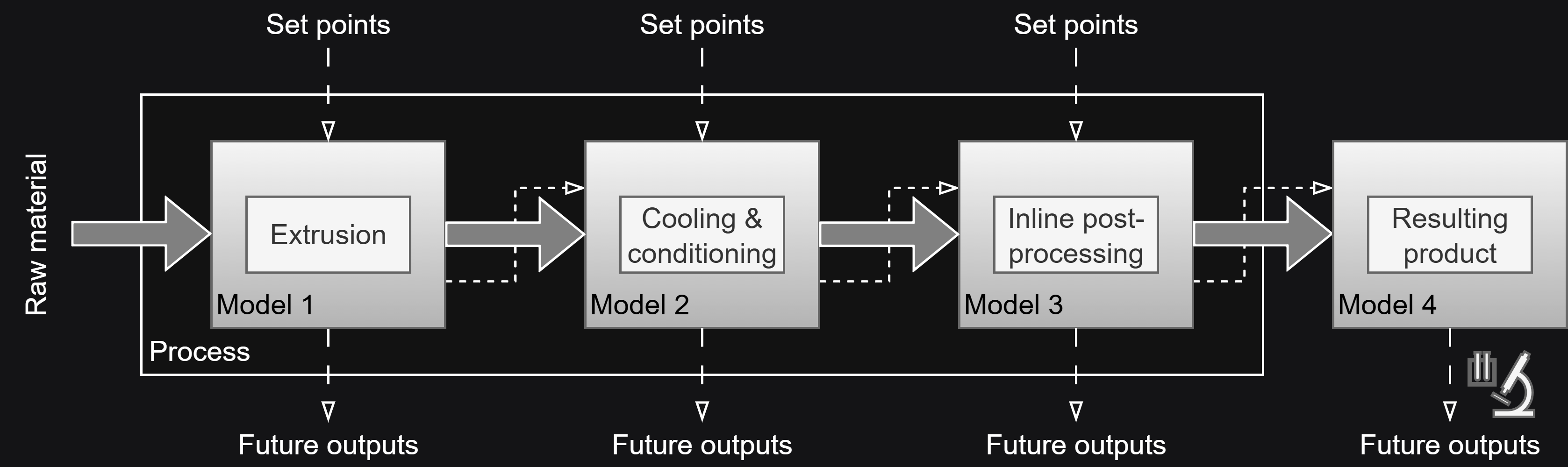
At jora.tech we introduce a new approach to model, predict and optimize the dynamic behaviour of entire extrusion lines by fusing data, physics and process expertise into a holistic method. Relying on known or identified causal dependencies and physics-informed state propagation (dashed lines in Figure 2) significantly increases robustness and explainability while addressing spurious correlations in the process.
For this purpose, we identify the main process stages, set points and states, build targeted state-models and integrate them into an end-to-end process model via state propagation (see Figure 2). Additionally, we explicitly include physical knowledge directly via analytical equations or via guardrails during training the AI models whenever possible.
The resulting hybrid AI models are capable of predicting the future behaviour of entire extrusion lines for up to two hours in advance allowing to mitigate upcoming issues proactively while addressing unexpected disturbances quickly based on our real-time control platform.
Figure 2: Structured modelling approach integrating data, physics and process expertise.
An important aspect that differentiates our approach from other solutions is that we always consider the process from an end-to-end perspective including everything from the material supply to quality measurements at the end of the line and beyond. As a consequence, our solutions enable a holistic optimization of all relevant factors simultaneously and continuously.
Based on our unique approach to model continuous production processes, the jora.tech platform enables real-time optimization with several core use cases ranging from human-in-the-loop (Figure 3) to fully automated predictive control (Figure 4):
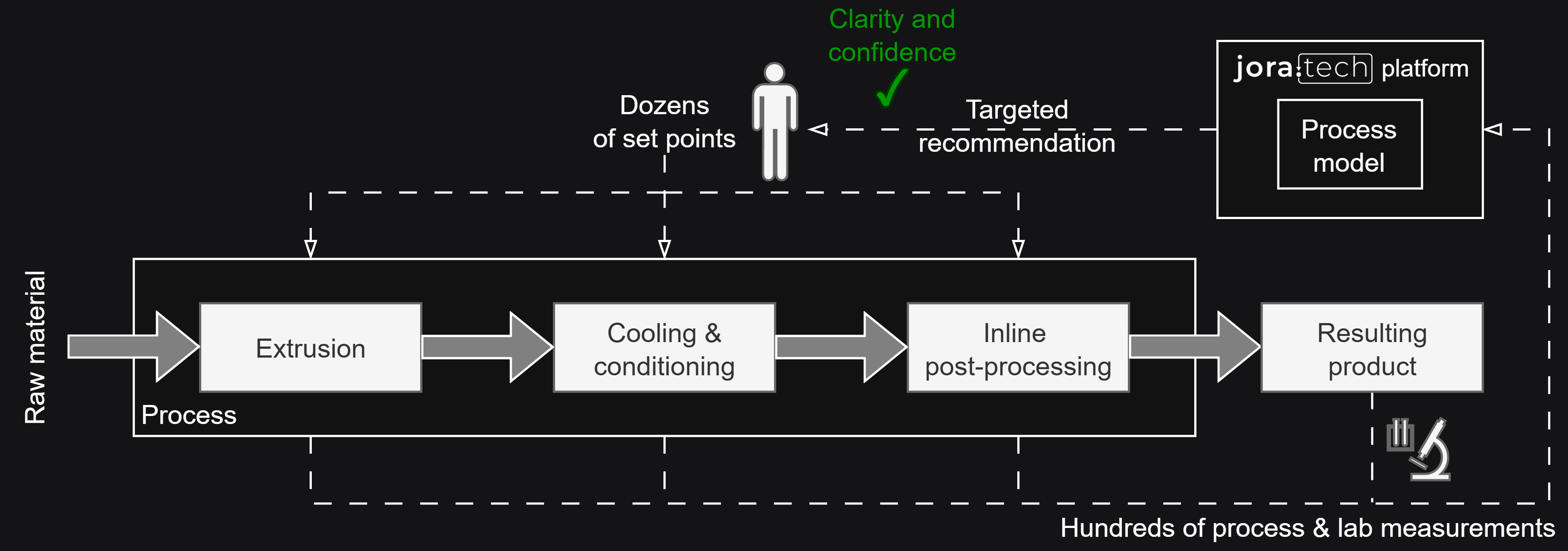
Figure 3: Human-in-the-loop use cases focused on what-if analysis and targeted recommendations.
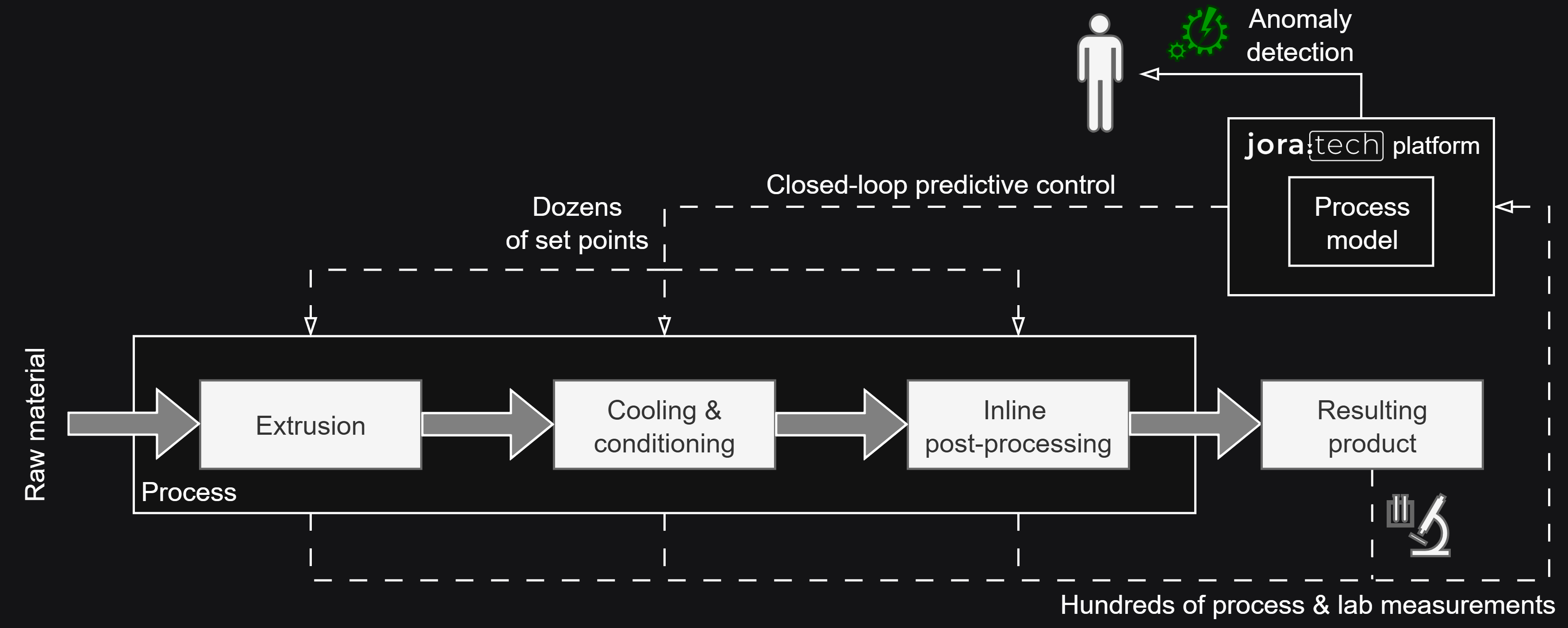
Figure 4: Fully automated closed-loop control via the jora.tech platform and underlying process models.
As a result of these use cases, jora.tech changes the way how production is done by moving from reactive to predictive optimizations. To ensure its applicability, the underlying platform is modular by design allowing tight integration in any existing infrastructure acknowledging the heterogenous reality of modern OT and IT environments.
The underlying methods for modelling and controlling continuous production processes, most notably extrusion lines, are the result of several years of cooperative research among scientific and industrial partners. As a consequence, comprehensive industrial validation with actual extrusion lines revealed the following benefits of applying these methods:
As a result, depending on the complexity of the extrusion line, significant savings are expected when data, physics and process expertise are combined for AI-driven process control. Importantly, while the example above focuses on polymer extrusion, the underlying methods for modelling and optimization are applicable to continuous production processes in general.
Want to know more about our approach? Get in touch and let’s discuss on how jora.tech can help elevate your production to the next level!
our-approach-in-a-nutshell
