Pipes
Maintain tighter wall thickness and meter-weight tolerances while reducing excessive material safety margins.


Predictive process intelligence for extrusion
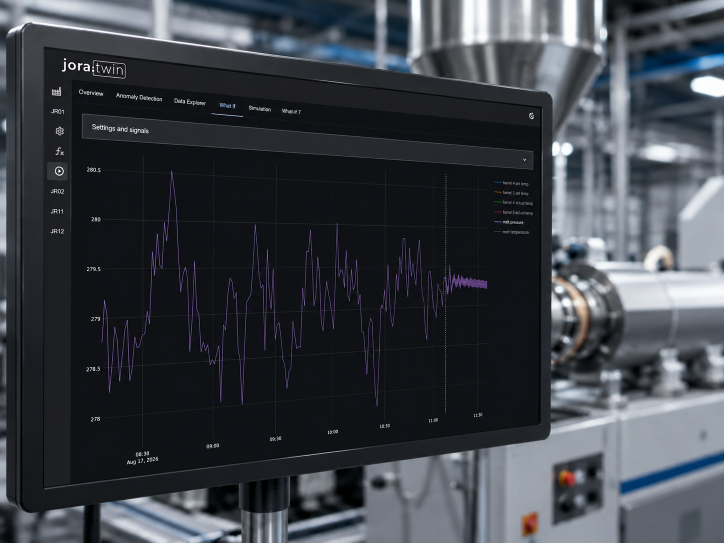
Reduce material waste, stabilize product quality and support operators – even when raw materials and process conditions fluctuate. jora.twin predicts how your production line will behave in real time and continuously adjusts the set points that keep it within its optimal operating window.
Our partners
Our partners. Hover or focus to pause the animation.

.png)
.jpg)
.png)
Industrial application
jora.twin is designed for complex, continuous lines where small upstream changes can create expensive downstream variation.
Maintain tighter wall thickness and meter-weight tolerances while reducing excessive material safety margins.
Stabilize dimensional quality across changing products, operating conditions and production shifts.
Detect process drift early and keep film thickness stable in high-throughput production environments.
Stabilize highly variable processes and reduce excessive material and energy consumption in plate extrusion.
Anticipate changing feedstock and recycled materials before they result in off-spec production.
The operational challenge
Most plants do not lack signals. They lack a reliable way to connect signals across the line, anticipate their effect on quality and decide what to change before value is lost.
Operators balance dozens of set points, hundreds of process signals and delayed quality feedback. By the time a deviation becomes visible, off-spec material may already have been produced.
Feedstock, ambient conditions and upstream disturbances affect the product throughout the entire line. Local control loops often react only after these effects have propagated downstream.
Production teams add material buffers, reduce speed or operate conservatively. These precautions protect specifications, but quietly increase material use and unit costs.
Experienced operators recognize patterns that are difficult to formalize. When this knowledge remains tied to individuals, performance can vary significantly between shifts and sites.
How it works
jora.twin turns historical and live plant data into a dynamic model of the complete production line – then uses that model to predict outcomes and recommend the best response.
Connect process, machine, environmental and quality data in a dynamic end-to-end model of your line.
Forecast how relevant process states and product properties will develop before deviations become visible.
Calculate the set-point changes most likely to restore or improve performance within defined targets and limits.
Let operators review recommendations, confirm them or apply them automatically inside validated operating boundaries.
Operational outcomes
Create value where process uncertainty currently forces your team to waste material, slow the line or react under pressure.
Reduce scrap and material safety margins with better visibility into what the product will do next.
Keep critical properties closer to target despite changing feedstock, products, shifts and ambient conditions.
Detect process drift earlier and recover faster without relying on slow trial-and-error adjustments.
Give every shift consistent, data-backed guidance while keeping operators in control.
jora.twin applications
Start with the decision that creates the strongest operational leverage, then expand on the same process model.
Explore historical process data and label relevant events and operating conditions. Turn your team’s process knowledge into context for model training.
Test set-point changes virtually and see their predicted effect before touching the live process. Work backwards from a target property to the inputs most likely to achieve it.
Recognize unfamiliar operating patterns early and narrow the search to the component or subsystem most likely responsible.
Continuously calculate set points that keep defined product properties within target – making self-optimizing extrusion a reality.
Industries
Different processes create different sources of variability. jora.twin adapts the same predictive foundation to the signals, constraints and quality targets that matter on each line.
Compensate for changing raw materials, recycled content and process conditions before compound quality drifts.
02Keep dimensions and product properties stable across the complete line – from changing inputs to downstream quality.
Support more stable processing when input streams and material properties vary.
Technology
We go beyond black-box machine learning. Historical and live data provide the signal, physical principles provide guardrails, and process expertise provides the context needed to create reliable models for each production environment.
Plant data reveals relationships across sensors, actuators, environmental conditions and quality measurements that are difficult to detect manually.
Physical principles and causal dependencies keep model behavior consistent with how the process can actually evolve across the line.
Engineers and operators define the context, limits and objectives that turn model output into useful production decisions.
Get started
Start with one focused use case and one production line. Validate the data, prove the operational value and expand only when the result is clear.
We assess data availability, signal quality and promising use cases. Together, we define a focused pilot with clear technical and business targets.
We build and validate the first line-specific model together with your team, demonstrating its value against the agreed production and business targets.
After initial training, your process experts independently build and deploy further models with jora.twin, expanding to new lines and use cases through self-service.
1–2 days
Pilot scope defined
3–4 weeks
Value validated
Scale line by line
Free data pre-check
Find out whether your existing production data is ready for predictive optimization – and where the strongest first use case lies.
Book a free data pre-check
